
Freight
Mar 01, 2026
How the 2026 Iran War Is Reshaping the Global Freight Market
The escalation of military conflict involving Iran at the end of February 2026 has triggered the most severe shock to global logistics since the early pandemic years.
Coordinated U.S.‑Israeli strikes on Iranian military and nuclear sites on February 28, 2026 set off a rapid chain of retaliatory actions by Iran’s Islamic Revolutionary Guard Corps (IRGC), abruptly reshaping air, ocean, and energy supply chains worldwide. [shipmaximum.com]
As of March 2, 2026, the freight market is experiencing simultaneous disruptions across air, sea, and energy infrastructure, with chokepoints closed, airports constrained, vessels idled, and rates climbing globally. The following is a consolidated view of the crisis as reported by major freight intelligence sources and global news agencies.
1. Ocean Freight: Global Chokepoints Under Extreme Stress
Strait of Hormuz: Fully Closed to Commercial Traffic
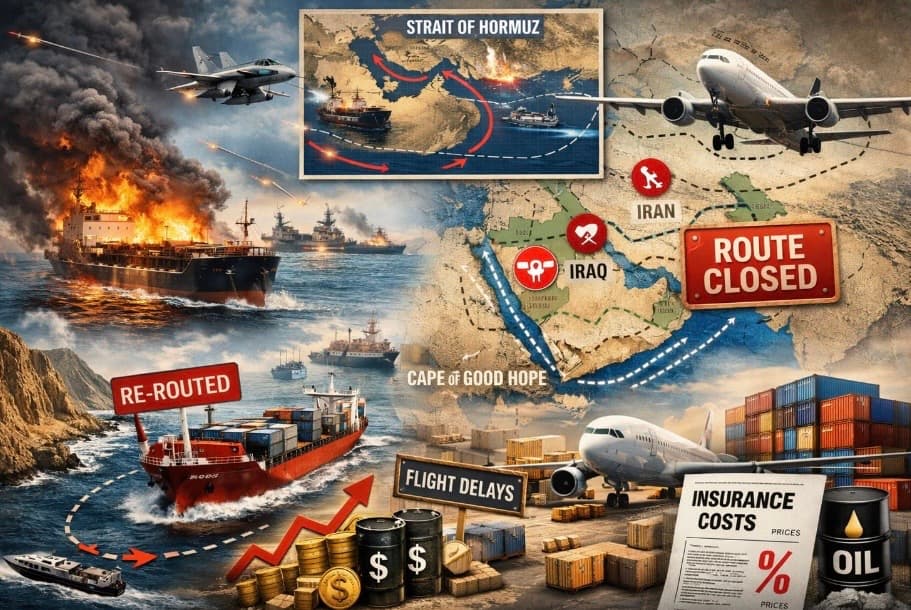
Iran declared the Strait of Hormuz closed to all commercial vessels immediately after retaliatory missile strikes, bringing movements in one of the world’s most essential shipping corridors to a standstill. Satellite data and AIS vessel tracking show tankers and container ships backing up near Fujairah and along GCC coasts. [shipmaximum.com]
The closure affects:
- ~20% of global oil shipments, historically moving through the strait. [cnbc.com]
- LNG exports from Qatar, which has also halted production due to Iranian strikes on energy facilities. [al-monitor.com]
Bab el‑Mandeb & Suez Canal: High‑Risk but Not Closed
Major carriers including Maersk, MSC, and Hapag‑Lloyd have suspended or rerouted transits through the Bab el‑Mandeb Strait due to fear of spillover attacks. This has forced vessels onto the longer Cape of Good Hope route. [cnbc.com]
This rerouting impacts:
- Middle East–India to Mediterranean lanes
- Middle East–India to U.S. East Coast services
- Asia–Europe flows reliant on the Suez corridor [cnbc.com]
Gulf Ports: Major Operational Disruptions
Direct calls to major Gulf ports are effectively impossible due to ocean carrier suspensions:
- Jebel Ali (UAE) – inaccessible via direct ocean call due to Hormuz closure. [shipmaximum.com]
- Doha / Hamad Port (Qatar) – similarly cut off from standard ocean routes. [shipmaximum.com]
Resulting Ocean Freight Bottlenecks
Across the Middle East and Indian Ocean region, carriers report:
- Blank sailings and vessel bunching
- Equipment imbalance
- Heavy anchorage congestion near Iraq, Saudi Arabia, UAE, Qatar
- Emergency surcharges from carriers such as Hapag‑Lloyd and CMA CGM [arabnews.com]
2. Air Freight: Widespread Airspace Closures and Airport Disruptions
GCC Airspace Suspended
On March 1, 2026, Gulf Cooperation Council (GCC) airspace — including the skies over the UAE, Qatar, Bahrain, Kuwait, and parts of Saudi Arabia — was suspended or heavily restricted following missile exchanges across the region. [shipmaximum.com]
Airports Affected (Closures / Major Disruptions)
While not all airports have fully closed, several major hubs are experiencing severe operational constraints, including cancellations, diversions, and reduced cargo capacity:
- Dubai International Airport (DXB) – experiencing flight cancellations and operational restrictions. [futureforwarding.com]
- Hamad International Airport (Doha) – similar disruptions with flight suspensions and diversions. [futureforwarding.com]
- Other UAE airports — potential shutdowns or restrictions noted by freight forwarders watching the region closely. [economictimes.indiatimes.com]
Air Freight Bottlenecks
- Rerouting of Asia–Europe and Asia–Middle East air corridors due to Gulf airspace restrictions. [futureforwarding.com]
- Reduced belly‑hold capacity as passenger flights cancel. [futureforwarding.com]
- Volatile schedules and sudden closure risks
- Charter demand and airfreight rates spiking globally
- Reports indicate 18% of total global airfreight capacity has been removed from the market due to the conflict. [arabnews.com]
3. Energy Infrastructure & Knock‑On Supply Chain Effects
Strikes on Gulf Energy Facilities
Iran’s retaliatory missile and drone attacks have hit multiple critical sites:
- Qatar: LNG facilities in Ras Laffan and Mesaieed (LNG production halted). [al-monitor.com]
- Saudi Arabia: Ras Tanura refinery (operations halted for safety assessment). [al-monitor.com]
Energy facility shutdowns exacerbate:
- Fuel price spikes
- Bunker fuel surcharges on ocean freight
- Airline operating costs and war‑risk insurance fees
4. Impacted Countries & Trade Routes
Below is a consolidated list of countries and trade corridors currently experiencing major freight disruptions:
Countries with Major Airspace or Logistics Disruptions
- Iran – primary conflict zone, no commercial overflights
- Iraq – airspace restrictions, missile activity risks [futureforwarding.com]
- Israel – airspace intermittently restricted due to missile exchanges [futureforwarding.com]
- Qatar – airport disruptions; LNG production halted [futureforwarding.com], [al-monitor.com]
- UAE – Dubai, Abu Dhabi affected by airspace suspensions and port access limitations [futureforwarding.com]
- Bahrain / Kuwait – restricted Gulf airspace forcing reroutes [futureforwarding.com]
- Saudi Arabia – energy infrastructure strikes; vessel congestion near its coasts [al-monitor.com], [arabnews.com]
Trade Routes with Severe Bottlenecks
1. Strait of Hormuz
- Fully closed to commercial shipping
- Backlogs of over 150 tankers & LNG carriers reported near chokepoint [arabnews.com]
2. Bab el‑Mandeb → Suez Canal corridor
- High‑risk zone
- Carriers pausing transits and rerouting around Africa [cnbc.com]
3. Asia–Europe Air Corridors (via Gulf)
- Forced to reroute north or south away from Iran, Iraq, and GCC airspace
- Increased transit times and reduced capacity [futureforwarding.com]
4. Middle East–India–Mediterranean Routes
- Maersk and other carriers shifting to Cape of Good Hope routing
- Delays of 10–20 days common [cnbc.com]
5. Indian Exporter Routes via Dubai & Gulf Hubs
- Key redistribution hub Dubai facing disruptions, raising expected freight cost increases of 25–30% for some exporters. [economictimes.indiatimes.com]
Conclusion
The 2026 war with Iran has rapidly evolved into a global freight crisis, simultaneously affecting ocean shipping, air cargo, and energy supply chains. With the Strait of Hormuz closed, Gulf airspace restricted, and major airports and refineries temporarily offline, the world’s trade infrastructure is experiencing cascading bottlenecks and historically high volatility.
Until airspace reopens and maritime risk eases, shippers should expect:
- Longer transit times
- Higher costs (war‑risk surcharges & fuel premiums)
- Port congestion and equipment shortages
- Highly unstable vessel and flight scheduling