
Road
Feb 08, 2026
The Future of Truck Driving: Why Remote-Operated Trucks May Define the Next Era of Freight
For more than a decade, headlines have predicted that autonomous trucks would soon replace human drivers. Yet as the industry steps into 2026, a different reality is emerging. Instead of fully driverless highways, the freight sector is converging on a hybrid model—one where automation handles routine driving, and trained human operators supervise or control trucks from remote command centers. This “driver behind the screens” model is increasingly seen as the most practical and scalable path forward.
Why Fully Driverless Hasn’t Taken Over (Yet)
The slowed rollout of fully driverless trucks stems from persistent real‑world challenges: unpredictable human behavior, construction zones, harsh weather, complex edge cases, and regulatory barriers. Even leading autonomous trucking companies acknowledge these limitations. For example, Aurora Innovation—one of the most advanced players—has made progress but continues to face regulatory, insurance, and workforce hurdles that limit operations to highly controlled corridors. [technical.ly]
Similarly, despite years of testing, no manufacturer or startup has yet deployed fully autonomous platooning where trailing trucks operate without any humans on board. Human intervention remains vital for safety and operational continuity. [nextbigfuture.com]
Introducing the Hybrid Model: Remote‑Operated Trucking
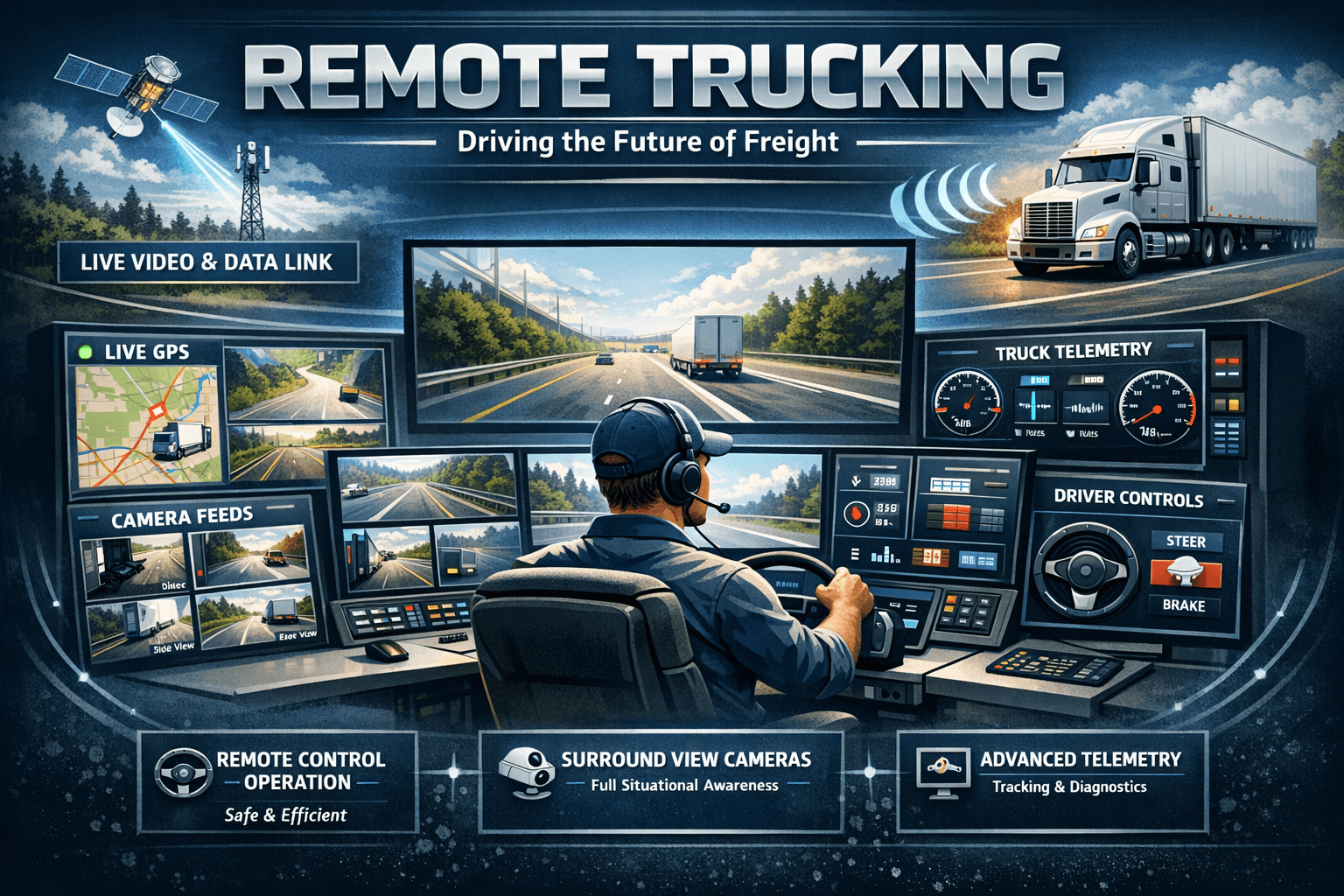
A growing set of logistics and autonomous vehicle companies now view remote operation—teleoperation—as the bridge between traditional trucking and full autonomy. In this model, a human operator sits in a control center equipped with screens, telemetry dashboards, and multi‑angle camera feeds, allowing them to control or supervise trucks from miles away.
Teleoperation in Action
- FERNRIDE and DB Schenker have demonstrated remote‑operated yard trucks where operators use steering wheels, pedals, and joysticks from a workstation, sending real‑time commands to the vehicle hundreds of kilometers away. [dbschenker.com]
- Kodiak Robotics and Vay have launched a hybrid system that pairs AI‑powered autonomous navigation with human teleoperators who can take control when needed. This allows autonomous trucks to run long-haul stretches while humans handle complex maneuvers or challenging environments. [linkedin.com]
- Einride's Remote Interface enables operators to control multiple electric autonomous vehicles, turning trucking into a job where drivers work from stable office environments. Einride argues that this will create thousands of new jobs, not eliminate them. [einride.tech]
Across these examples, the pattern is clear: teleoperation is becoming foundational to the future of freight.
Why Remote Trucking Makes Sense
1. Solving Driver Shortages
Driver shortages remain one of the most significant pressures on the trucking industry. McKinsey research indicates the U.S. is short more than 80,000 drivers, a number projected to double by 2030. Remote operation allows experienced drivers to stay in the workforce while enjoying far better working conditions. [mckinsey.com]
2. A Better Work Environment
Remote truck driving turns a physically taxing job—long hours, isolation, safety risks—into a stable, predictable, office‑based career. Einride reports that remote operation offers safer, more regular hours compared to conventional trucking. [einride.tech]
3. Increased Safety Through Dual‑Layer Control
Hybrid systems embed safety at two levels:
- Autonomous systems manage routine tasks and monitor surroundings continuously.
- Human operators intervene instantly when edge cases arise, such as blocked lanes or complex navigation scenarios.
This dual‑layer safety model is already proving effective in commercial pilots. [linkedin.com]
4. Better Operational Efficiency
Teleoperation prevents vehicles from getting “stuck” when automation encounters a scenario it cannot solve. Researchers note that remote assistance significantly reduces disengagements—moments when automation must be overridden for safety. [arxiv.org]
5. Realistic Regulatory Path
The regulatory landscape is moving deliberately—especially for hazardous materials. U.S. regulators are actively gathering feedback on how compliance should work when no human is in the cab, underscoring that remote oversight may remain required for years. [tanktransport.com]
How the Hybrid Model Works
A typical remote trucking setup includes:
- Live Video Feeds from multiple cameras
- Real‑time Telemetry (speed, engine data, braking, etc.)
- Driver Controls enabling remote steering, acceleration, braking
- High‑bandwidth connectivity via 5G or satellite links
- AI‑assisted autonomy for highway cruising and obstacle detection
Often, automation handles 90% of driving, while the remote operator manages the remaining 10%—the tricky parts.
The Road Ahead: Humans Still Essential
While fully autonomous trucks may eventually expand, the foreseeable future will rely heavily on human expertise. Remote operators provide:
- Judgment in unpredictable scenarios
- Oversight for safety
- Problem‑solving beyond AI’s capability
- First‑ and last‑mile navigation
- Rapid responses during technical faults or emergencies
This aligns with industry findings that true Level 5 autonomy is still years away from mainstream adoption. [marshalltruck.com]
Conclusion: The Future is Hybrid, Not Driverless
The next era of trucking won’t remove the driver—it will relocate them. Remote trucking blends the efficiency of automation with the irreplaceable decision‑making skills of human operators. This model increases safety, stabilizes staffing, reduces operational costs, and redefines the trucking profession into a modern, tech‑forward career path.
Another reason that we think companies will hold off from being fully driverless -- slashing the entire industry could lead to broader problems. There are 3-4 million active truck drivers in the US today. There is just no way you will be able to transition them accordingly that fast into another field. The ripple effects of unemployment towards truck drivers will not be good. Trucking has been a backbone for the nation's economy. Lastly, from an insurance & liability perspective, driverless will redefine insurance underwriting for trucking. This has never been completed before -- the disruption upon this would be detrimental as well. We believe that there will be layoffs & driverless freight however, we do not think that it will completely vanish. I believe hybrid is the frontrunner opposed to solely driverless freight.
As companies like FERNRIDE, Kodiak, Vay, and Einride scale their hybrid systems, the industry is making one thing clear:
The future of truck driving isn’t driverless—it’s driver‑elevated.