
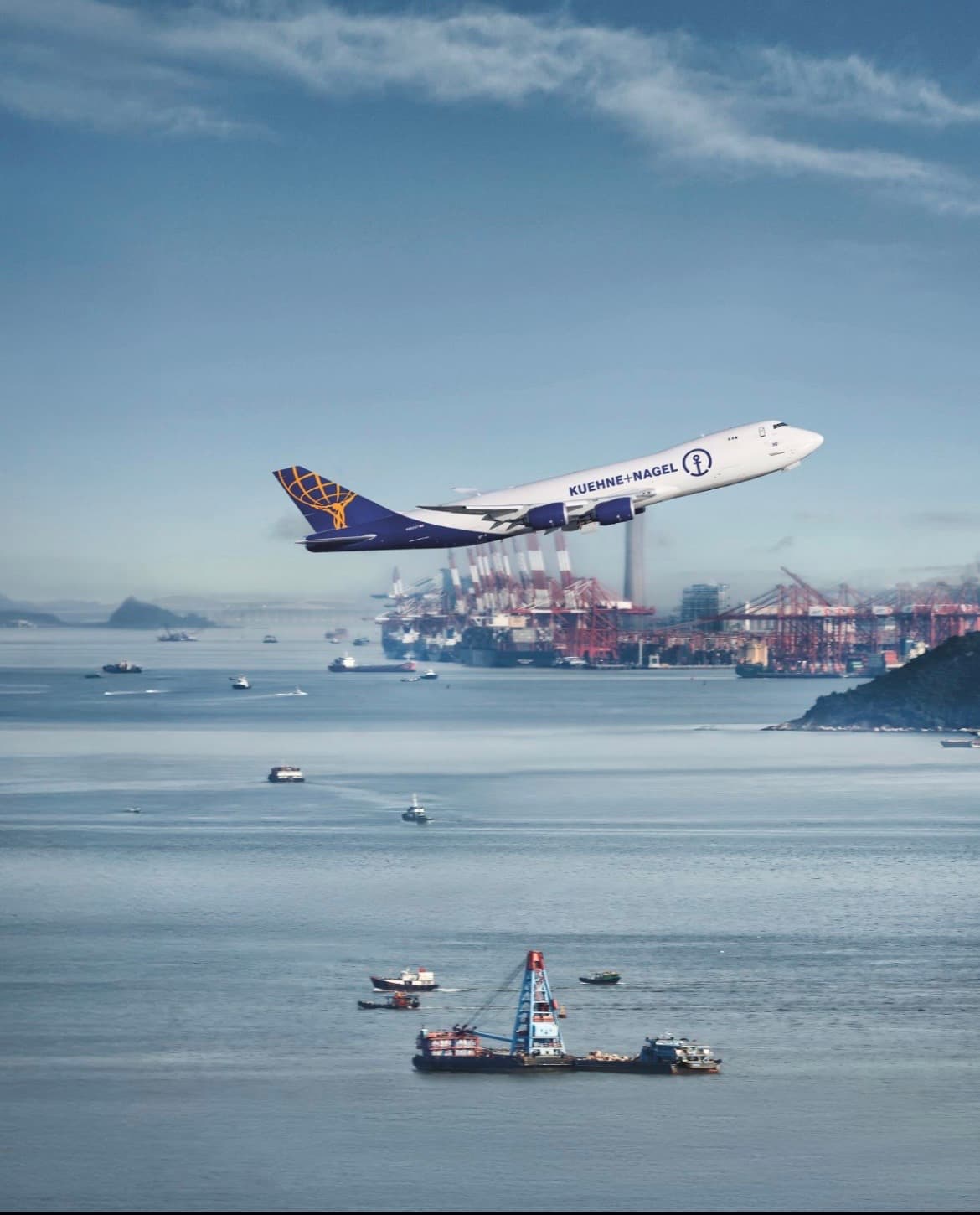
Air
Mar 06, 2026
Kuehne + Nagel Remains #1 in Sea & Air Logistics Despite Market Turbulence and the DSV Acquisition
In an era defined by unprecedented supply-chain disruption, volatile tariffs, and geopolitical instability, Kuehne + Nagel (K+N) has once again emerged as the world's leading logistics provider in both sea and air freight volumes.
Even with the industry‑shifting DSV–DB Schenker acquisition reshaping competitive dynamics, K+N has demonstrated remarkable resilience and maintained its global #1 position in 2025 across both modes. [linkedin.com]
This leadership comes at a time when companies across the logistics landscape battle declining demand, rerouted trade lanes, high freight rates, and constantly evolving regulatory environments.
Leading the Industry in Both Sea & Air Freight
Sea Freight: Sustained Global #1 Position
Kuehne + Nagel ended 2025 as the world’s top sea freight forwarder, handling 4.3 million TEU in container volumes despite a cooling global trade environment. This performance reflects not only its unmatched network strength but also its expansion among small and medium‑sized customers, who accounted for half of total volumes for the first time. [itln.in]
Air Freight: Holding the #1 Spot Despite DSV’s Expansion
Even after DSV’s acquisition of DB Schenker—a move widely expected to challenge global ranking tables—K+N remained the world’s largest airfreight forwarder by volume, handling 2.2 million tonnes in 2025, surpassing DSV’s 2 million. DSV briefly overtook in Q3 due to consolidation effects, but K+N regained leadership in Q4, demonstrating strong operational momentum. [thelogisticnews.com]
Industry analysts confirm that K+N’s strong network, diversified customer base, and technology-enabled operations have kept it firmly ahead even amid consolidation waves. [indiaseatradenews.com]
A Freight Market Under Pressure: Volumes, Tariffs, and Geopolitical Tensions
While K+N celebrates its market‑leading position, the broader freight environment paints a more challenging picture. Global trade systems have been strained by simultaneous crises—geopolitical conflicts, new tariffs, route disruptions, and infrastructure bottlenecks—which have reshaped how goods flow across the world.
Geopolitical Disruptions Are Rewriting Global Trade Routes
Escalating Middle East tensions have triggered major congestion across vital shipping lanes such as the Strait of Hormuz, with more than 150 vessels forced to anchor amid strikes and port suspensions. These disruptions have resulted in soaring oil prices and ripple effects across global supply chains. [weforum.org]
UNCTAD similarly warns that geopolitical tensions, rerouting around conflict zones, and new trade barriers are reshaping maritime logistics—slowing growth to its weakest rate in years, increasing distances traveled, and driving up costs. [news.un.org], [unctad.org]
Tariff Volatility Is Hammering Import and Export Flows
Tariffs are now one of the most destabilizing forces in freight:
- The U.S. Supreme Court overturned the Trump administration’s broad tariff strategy, prompting new global import duties of up to 10–15% under alternative legal authority. [weforum.org]
- In mid‑2025, U.S. emergency tariff powers briefly spiked duties on certain Chinese imports to 145%, halting trade on multiple lanes before a 90‑day truce reduced rates back to ~30%. [unicargo.com]
These sudden policy swings have forced shippers to alternately rush cargo or delay orders, creating unpredictable peaks and troughs in global freight demand—especially across transpacific lanes.
Ports and Inland Networks Are Facing Severe Bottlenecks
A convergence of labor shortages, congestion, low water levels impacting barge flows, and infrastructure strain has overwhelmed ports in Europe and North America. Major hubs such as Rotterdam, Antwerp, and Hamburg have faced wait times of 5–6 days or longer, while U.S. West Coast ports continue to experience import‑driven congestion and equipment shortages. [shipuniverse.com]
These bottlenecks prolong transit times, increase shipping costs, and push carriers toward schedule omissions and alternative routes—further complicating logistics planning.
How Kuehne + Nagel Continues to Win in a Turbulent Market
Despite these headwinds, Kuehne + Nagel’s sustained leadership is the result of several strategic advantages:
1. Diversified Customer Base & Balanced Volumes
Sea and air volumes grew 2% and 7% respectively in H1 2025—well above market rate—driven by strong growth in cloud infrastructure, perishables, and semiconductor segments. [freightweek.org]
2. Technology, AI, and Digitalization
K+N has continued heavy investment in automation, AI, and digital freight management, boosting both customer visibility and operational efficiency. [linkedin.com]
3. Capitalizing on Competitor Integration Gaps
During DSV’s complex multi‑year integration of DB Schenker, Kuehne + Nagel has strategically targeted opportunities in tender cycles, especially in airfreight where customer switching occurs more quickly. [hps-trade.co.th]
4. Global Network Strength & Resilience
K+N’s robust global networks allow it to offset regional downturns with gains in other markets—a key advantage during volatile geopolitical periods. [freightweek.org]
Conclusion: Market Chaos, Clear Leadership
In a freight environment defined by uncertainty, Kuehne + Nagel has proven that scale, strategy, and operational discipline make a decisive difference. While global trade continues to battle tariff shocks, geopolitical conflict, and structural bottlenecks, K+N stands out not only for weathering the storm but for expanding its lead in both sea and air logistics.
The company’s ability to maintain global #1 position—even against a newly enlarged DSV—is a testament to its forward‑looking strategy, technology investments, and enduring customer trust.
Kuehne + Nagel enters 2026 not just as a market leader, but as a stabilizing force in a freight world that desperately needs one.